
Nowcasting revisions using the generalized Kishor-Koenig family
Source:vignettes/nowcasting-revisions-kk.Rmd
nowcasting-revisions-kk.RmdThis vignette describes the generalized Kishor-Koenig (KK) revision
model and its nested variants as implemented in
reviser::kk_nowcast(). The exposition uses the same
Durbin-Koopman state-space notation that appears throughout the package
documentation: observation matrices are denoted by
,
transition matrices by
,
shock-loading matrices by
,
and disturbance covariance matrices by
and
(Durbin and Koopman
2012).
The motivation is straightforward. Early releases of macroeconomic series are often revised several times before they settle near a stable value. Rather than ignoring that revision process, the KK family models the vector of releases directly and uses the Kalman filter to infer the latent efficient estimate.
Revision system
Suppose that an efficient estimate becomes available after revisions. Let denote the -th release for reference period , where . Following Strohsal and Wolf (2020), stack the efficient estimates and the observed real-time releases as
The generalized KK model is
The companion-form transition matrix is
and the gain matrix is
Intuitively, governs the dynamics of the efficient estimate, while controls how quickly incoming releases absorb new information. The covariance matrices and describe uncertainty in the latent efficient estimate and the published releases, respectively.
Nested models
The generalized KK setup nests two useful special cases.
- The Classical measurement-error model is obtained by setting . In that case, published data are noisy measurements of the latent efficient estimate, with no revision persistence beyond the state dynamics.
- The Howrey model (Howrey 1978) allows revision persistence but restricts the gain matrix by imposing for and .
The model argument in kk_nowcast() selects
among these specifications: "KK", "Howrey",
and "Classical".
Durbin-Koopman state-space form
To run filtering and smoothing, reviser casts the KK
system into the standard time-invariant state-space form
Define the augmented state as
With this choice of state vector, the implementation in
kk_to_ss() uses
The observation disturbance is set to zero, so . All uncertainty is collected in the state disturbance covariance matrix
This is exactly the Durbin-Koopman representation used internally by
reviser: the Kalman filter and smoother operate on
,
while the KK-specific parameters
remain the economically interpretable layer.
Estimation in reviser
kk_nowcast() supports three estimators.
-
method = "SUR"estimates the original revision equations jointly by seemingly unrelated regression usingsystemfit::nlsystemfit(). -
method = "OLS"estimates the equations one by one. This is fast, but the cross-equation restrictions are not fully efficient. -
method = "MLE"estimates the state-space model by maximum likelihood using the Kalman filter.
For applied work, the MLE route is usually the most flexible because it supports information criteria, Hessian- or QML-based standard errors, and filtered or smoothed states directly from the state-space model.
Example: Euro Area GDP revisions
We illustrate the workflow with Euro Area GDP growth from
reviser::gdp. We first identify an efficient release among
the first 15 vintages, then estimate the full KK model.
library(reviser)
library(dplyr)
library(tidyr)
library(tsbox)

gdp <- reviser::gdp |>
  tsbox::ts_pc() |>
  dplyr::filter(
    id == "EA",
    time >= min(pub_date),
    time <= as.Date("2020-01-01")
  ) |>
  tidyr::drop_na()

df <- get_nth_release(gdp, n = 0:14)
final_release <- get_nth_release(gdp, n = 15)

efficient_release <- load_or_build_vignette_result(
  "nowcasting-revisions-kk-efficient-release.rds",
  function() get_first_efficient_release(df, final_release)
)
summary(efficient_release)
#> Efficient release:  2
#>
#> Model summary:
#>
#> Call:
#> stats::lm(formula = formula, data = df_wide)
#>
#> Residuals:
#>      Min       1Q   Median       3Q      Max
#> -0.34873 -0.08185 -0.00706  0.10475  0.31533
#>
#> Coefficients:
#>             Estimate Std. Error t value Pr(>|t|)
#> (Intercept)  0.03276    0.01775   1.846   0.0692 .
#> release_2    1.01446    0.02440  41.577   <2e-16 ***
#> ---
#> Signif. codes:  0 '***' 0.001 '**' 0.01 '*' 0.05 '.' 0.1 ' ' 1
#>
#> Residual standard error: 0.1428 on 68 degrees of freedom
#> Multiple R-squared:  0.9622, Adjusted R-squared:  0.9616
#> F-statistic:  1729 on 1 and 68 DF,  p-value: < 2.2e-16
#>
#>
#> Test summary:
#>
#> Linear hypothesis test:
#> (Intercept) = 0
#> release_2 = 1
#>
#> Model 1: restricted model
#> Model 2: final ~ release_2
#>
#> Note: Coefficient covariance matrix supplied.
#>
#>   Res.Df Df     F  Pr(>F)
#> 1     70
#> 2     68  2 2.743 0.07151 .
#> ---
#> Signif. codes:  0 '***' 0.001 '**' 0.01 '*' 0.05 '.' 0.1 ' ' 1

data_kk <- efficient_release$data
e <- efficient_release$e
The selected value of e tells us how many revision
rounds are needed before a release is statistically close to the final
benchmark.
fit_kk <- load_or_build_vignette_result(
  "nowcasting-revisions-kk-fit.rds",
  function() {
    kk_nowcast(
      df = data_kk,
      e = e,
      model = "KK",
      method = "MLE",
      solver_options = list(
        method = "L-BFGS-B",
        maxiter = 100,
        se_method = "hessian"
      )
    )
  }
)

summary(fit_kk)
#>
#> === Kishor-Koenig Model ===
#>
#> Convergence: Success
#> Log-likelihood: 125.7
#> AIC: -231.41
#> BIC: -198.23
#>
#> Parameter Estimates:
#>  Parameter Estimate Std.Error
#>         F0    0.633     0.131
#>       G0_0    0.950     0.031
#>       G0_1   -0.037     0.152
#>       G0_2   -0.181     0.220
#>       G1_0   -0.009     0.011
#>       G1_1    0.594     0.061
#>       G1_2    0.194     0.092
#>         v0    0.380     0.068
#>       eps0    0.008     0.001
#>       eps1    0.001     0.000
The parameter table reports the estimated transition coefficient , the gain-matrix elements , and the state and observation variances.
fit_kk$params
#>    Parameter     Estimate    Std.Error
#> 1         F0  0.632965335 0.1313813639
#> 2       G0_0  0.950076539 0.0308315303
#> 3       G0_1 -0.036660310 0.1517629398
#> 4       G0_2 -0.180790257 0.2201177887
#> 5       G1_0 -0.008913846 0.0109883743
#> 6       G1_1  0.594486360 0.0612313441
#> 7       G1_2  0.194005812 0.0915497686
#> 8         v0  0.379874788 0.0683792923
#> 9       eps0  0.007785910 0.0014196296
#> 10      eps1  0.001397112 0.0002435075
The states element contains filtered and smoothed
estimates of the latent state vector in tidy format.
fit_kk$states |>
  dplyr::filter(filter == "smoothed") |>
  dplyr::slice_tail(n = 8)
#> # A tibble: 8 × 7
#>   time       state           estimate lower upper filter   sample
#>   <date>     <chr>              <dbl> <dbl> <dbl> <chr>    <chr>
#> 1 2018-04-01 release_2_lag_2    0.654 0.652 0.656 smoothed in_sample
#> 2 2018-07-01 release_2_lag_2    0.370 0.368 0.372 smoothed in_sample
#> 3 2018-10-01 release_2_lag_2    0.414 0.412 0.416 smoothed in_sample
#> 4 2019-01-01 release_2_lag_2    0.136 0.134 0.138 smoothed in_sample
#> 5 2019-04-01 release_2_lag_2    0.307 0.305 0.309 smoothed in_sample
#> 6 2019-07-01 release_2_lag_2    0.441 0.439 0.443 smoothed in_sample
#> 7 2019-10-01 release_2_lag_2    0.147 0.146 0.149 smoothed in_sample
#> 8 2020-01-01 release_2_lag_2    0.299 0.297 0.301 smoothed in_sample
The default plot method shows the filtered estimate of the efficient release and its confidence interval.
plot(fit_kk)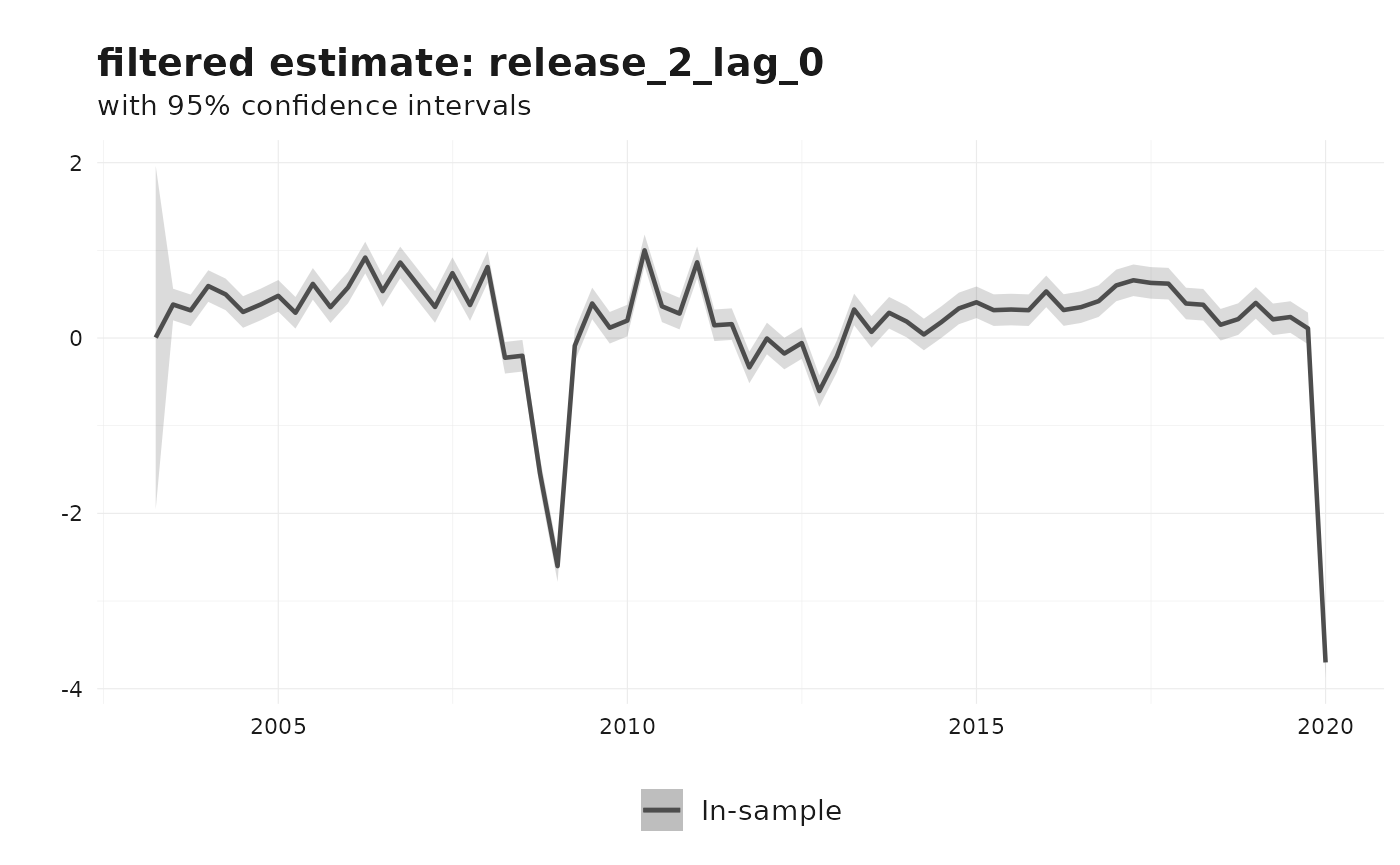
Other KK-family specifications
The same data can be estimated under the nested Howrey and Classical restrictions.
fit_howrey <- kk_nowcast(
  df = data_kk,
  e = e,
  model = "Howrey",
  method = "MLE"
)

fit_classical <- kk_nowcast(
  df = data_kk,
  e = e,
  model = "Classical",
  method = "MLE"
)
Those alternatives are useful when the unrestricted gain matrix of the full KK model is too parameter rich for the available sample.