seasight provides R tools for seasonal adjustment diagnostics, model comparison and reproducible HTML reporting. It builds on seasonal and X-13ARIMA-SEATS, with workflows aimed at official statistics, macroeconomic monitoring and production review.
seasight is designed for teams that need more than a one-off adjustment: transparent diagnostics, comparable candidates, readable reports, and a workflow that survives handover across analysts and over time.
Status: seasight is in a pre-submission stabilization phase. The 0.1.x series focuses on a stable core workflow, stronger tests, and review-ready documentation.
Why seasight
seasight complements rather than replaces seasonal.
- Use
seasonalwhen you want direct manual control of a specific X-13 spec. - Use
seasightwhen you want a reviewable workflow around those specs: screening for apparent seasonality, generating candidate models, ranking them with explicit diagnostics, and producing a report that colleagues can inspect without reading the source code first.
This is especially useful in official statistics and macroeconomic production workflows, where revisions, analyst turnover, and repeated model review all matter.
Workflow
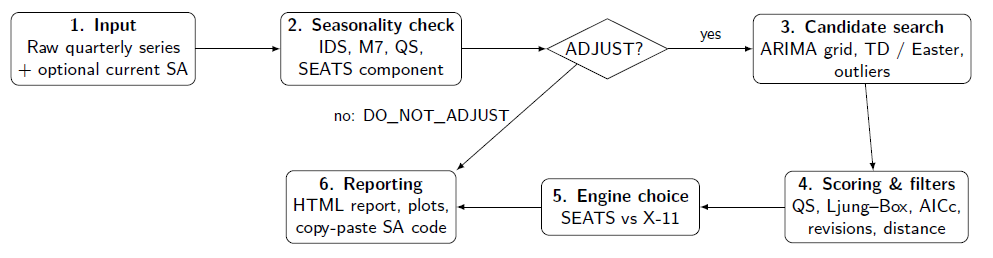
The package supports a six-step workflow:
- start from a raw quarterly or monthly series, with an optional current production adjustment;
- check whether adjustment is warranted at all;
- search across candidate ARIMA, trading-day, Easter, outlier, and engine choices;
- score and filter candidates using diagnostics such as QS, Ljung-Box, AICc, revisions, and distance to the incumbent;
- compare SEATS and X-11 when both are relevant;
- generate a self-contained HTML report with plots, rationale, and copy-paste
seasonal::seas()code.
The aim is not full automation without judgment. It is a human-in-the-loop review workflow with explicit rules and outputs that are easy to audit, communicate, and revisit later.
What You Can Do
- Screen for apparent seasonality with
sa_tests_model(),sa_existence_call(), andsa_is_do_not_adjust(). - Run a bounded candidate search with
auto_seasonal_analysis(). - Compare the preferred model with a current production model via
sa_should_switch(),sa_compare(), andsa_top_candidates_table(). - Build reproducible HTML reports with
sa_report_html(). - Supply explicit trading-day and moving-holiday regressors with
build_user_xreg()andtd_candidates.
Quick Start
library(seasight)
library(seasonal)

y <- AirPassengers

res <- auto_seasonal_analysis(y, max_specs = 3)

res$best
head(res$table)
res$seasonality$overall

out <- sa_report_html(
  y = y,
  max_specs = 3,
  outfile = tempfile("sa_airpassengers-", fileext = ".html")
)

out$report
Compare With a Current Production Model
library(seasight)
library(seasonal)

y <- AirPassengers

current_model <- seas(
  y,
  x11 = "",
  arima.model = c(0, 1, 1, 0, 1, 1),
  transform.function = "log"
)

res <- auto_seasonal_analysis(
  y = y,
  current_model = current_model,
  engine = "auto",
  max_specs = 3
)

sa_should_switch(res)

sa_report_html(
  y = y,
  current_model = current_model,
  max_specs = 3,
  outfile = tempfile("sa_airpassengers_with_baseline-", fileext = ".html")
)
For an ARIMA-only attribution check, set comparison_mode = "incumbent_fixed". This requires current_model and holds its selected transformation, calendar terms, fixed outliers and stored user regressors constant while candidate ARIMA specifications (and the requested engine) are refitted. Coefficients remain free. The candidate table records comparison_mode, regression_variables and outlier_variables.
Decision Logic In Brief
auto_seasonal_analysis() may fit several X-13 models: default specifications, optional seasonal::fivebestmdl() specifications, no-trading-day and trading-day candidates, and in engine = "auto" mode both SEATS and X-11 attempts. Use max_specs for quick exploratory runs and increase the grid only when you need a broader review.
Model ranking combines residual seasonality on the adjusted series (QS_p), Ljung-Box residual diagnostics, AICc, revision metrics for the top candidates, distance from any incumbent model, and an engine-preference penalty. The switching helper sa_should_switch() then compares the selected candidate with the incumbent. A change requires a material improvement in comparable AICc, acceptable absolute diagnostics, no material deterioration in QS or Ljung-Box p-values, and compliance with distance and seasonal-correlation safeguards. Identical adjustments are kept. Missing or non-comparable evidence is reported as "REVIEW_REQUIRED"; without an incumbent the result is "NO_BASELINE".
sa_report_html() writes an HTML file. In examples, use tempfile() or an explicit review-output path so report generation does not unexpectedly create files in your project root.
Built For Review
seasight was designed for settings where seasonal adjustment decisions need to be documented and explained, not just computed. The report output is meant to support internal review, communication with subject-matter experts, and reproducible handover across analysts.
Try Alternative Trading-Day Regressors
td_candidates should be a named list of ts or ts-boxable regressors aligned to y. seasight does not ship broad holiday calendars; production calendar data should come from an authoritative source for the country, sector and series being adjusted. The example below is artificial but copy-pasteable.
library(seasight)

y <- AirPassengers

month_length <- rep(c(31, 28, 31, 30, 31, 30, 31, 31, 30, 31, 30, 31), length.out = length(y))
td_len <- ts(month_length - mean(month_length), start = start(y), frequency = frequency(y))

td_candidates <- list(length_of_month = td_len)

res_td <- auto_seasonal_analysis(
  y = y,
  td_candidates = td_candidates,
  td_usertype = "td",
  include_easter = "auto",
  engine = "auto"
)

res_td$table[1, c(
  "model_label", "with_td", "td_name", "with_easter", "easter_window",
  "td_p", "score_100"
)]
With include_easter = "auto", X-13 tests whether Easter improves the model and selects among its supported Easter windows. Use "always" to impose easter[easter_len], or "off" to disable both inclusion and testing. The candidate table records the effect actually retained in with_easter and easter_window.
For moving-holiday pulses, use build_user_xreg():
diwali_dates <- as.Date(c(
  "2018-11-07", "2019-10-27", "2020-11-14", "2021-11-04",
  "2022-10-24", "2023-11-12", "2024-11-01"
))

td_holiday <- build_user_xreg(
  y = y,
  holidays = list(diwali = list(dates = diwali_dates, start = -1, end = 1)),
  td_usertype = "holiday"
)
Programmatic Diagnostics
library(seasight)
library(seasonal)

y <- AirPassengers
m <- seas(y)

diag_tbl <- sa_tests_model(m)
diag_tbl

sa_existence_call(diag_tbl)
extract_outliers(m)
sa_copyable_call(m, x_expr = "AirPassengers")
Learn More
- Getting started:
vignettes/seasight-getting-started.Rmd - Advanced usage:
vignettes/seasight-advanced.Rmd - Seasonal adjustment in practice:
vignettes/seasight-sa-practice.Rmd - SEATS seasonal component absent:
vignettes/seasight-seats-absent.Rmd
Citation
If you use seasight in research, policy work, or production documentation, please cite the package metadata:
citation("seasight")Contributing
Feedback from practitioners is welcome, especially from statistical offices, central banks, finance ministries and researchers working with real-time macroeconomic data and revisions. Please open issues for bugs, diagnostics gaps or report improvements.
Development setup, testing expectations and review-readiness notes are described in CONTRIBUTING.md. Normal local tests do not require tokens or external services; a GitHub token is only useful for checks that query GitHub metadata, such as pkgcheck.
All participants are expected to follow the project Code of Conduct.